The quickly escalating war between the United States, Israel and Iran has unfolded over the last week, but its roots span over many years of tensions rising in the Middle East. Here is a chronological breakdown of the conflict: how it started, developed and where it stands now.
For years, the United States and Israel have accused Iran of growing its nuclear program and developing ballistic missiles. Iran has also been accused of supporting armed groups like Hezbollah in Lebanon and other militias in Syria and Iraq. While Iran has adamantly denied the claims regarding nuclear weapons, the country has repeatedly fought with forces from the U.S. and Israel through sporadic missile exchanges and proxy disputes. In early 2026, these tensions rose after many different indirect negotiations between D.C. and Tehran over nuclear power failed.
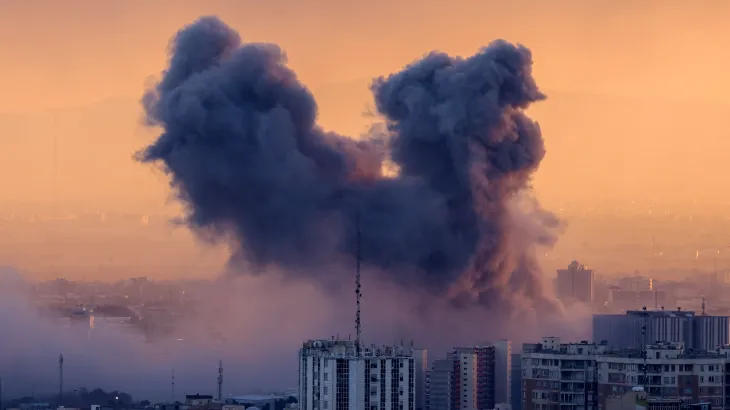
The current war began early on Feb. 28, when Israel and the United States initiated a large-scale military attack on Iran. This joint operation involved more than 100 aircraft. Their target being command centers, military buildings and infrastructure in many Iranian cities, including Tehran. The goal was to incapacitate Iran’s leadership and military abilities.
It can be argued that a big turning point came during that night when Iran’s Supreme Leader, Ayatollah Ali Khamenei, was killed in an airstrike in Tehran. This attack was successful in weakening Iran’s leadership structure, as it triggered a leadership crisis within Iran after confirming his death a few days later.
Within the country, the reaction to the death of Khamenei was mixed. In some cities, there were celebrations. Some Iranians who were in opposition of the government saw this as liberation and a potential end to a long period of repression. However, many others are fearful of the implications this may have. With continuing airstrikes and uncertainty about who will lead the country now, widespread anxiety is prominent.
Within hours of the strikes, Iran retaliated, launching several drones and ballistic missiles at U.S military bases within the Middle East and at cities in Israel. Several countries with American bases, including Kuwait, Qatar and Bahrain, reported attempted attacks on their military facilities.Some missiles were intercepted, but several caused great damage and casualties.
Among the damage of Feb. 28, a missile strike destroyed the Shajareh Tayyebeh girls’ elementary school in Minab. According to reports, the school had previously been used as a military facility but was later converted into a school that has been operating for over a decade. The United States and Israel have not confirmed responsibility for the strike and say that they do not intentionally target civilians, but Iranian officials blamed both countries and called it a violation of international humanitarian law. As of now, this bombing is the deadliest reported civilian incident of the war and has caused international outcry and condemnation.
Hezbollah in Lebanon (a powerful militant group backed by Iran) also retaliated by sending rockets and drones towards Israel. Israel responded with intense airstrikes on Hezbollah locations in Lebanon and also parts of Beirut, which forced huge civilian evacuations.
The war is taking place both in the air and at sea. The United States struck an Iranian drone carrier at sea and also sank an Iranian warship in the Indian Ocean. Because of this, global shipping has been disrupted through the Strait of Hormuz, a vital route of oil transport.
Casualties have climbed rapidly. As of March 4, it is reported that more than 1,000 people have been killed in Iran, along with an additional 880 reported deaths waiting classification. The fighting has displaced tens of thousands of civilians and raised fears of a wider regional war involving multiple countries.
Politically, the conflict has also heightened. President Donald Trump has demanded what he calls Iran’s “unconditional surrender,” and stated that the United States should play a critical role in building the leadership of Iran after Khamenei’s death. However, Iranian officials have vowed unwavering retaliation, warning that if attacks continue, the war will escalate further.
As this war enters its second week, the United Nations is calling for an immediate ceasefire and negotiations. But with both parties continuing strikes, the conflict is showing little sign of slowing down. For now, the war between Iran, Israel and the United States has become one of the most dangerous conflicts in the region in many years, and has the potential to reshape the balance of power across the Middle East.
This is a developing story.
Last updated March 6, 1:15 p.m.