
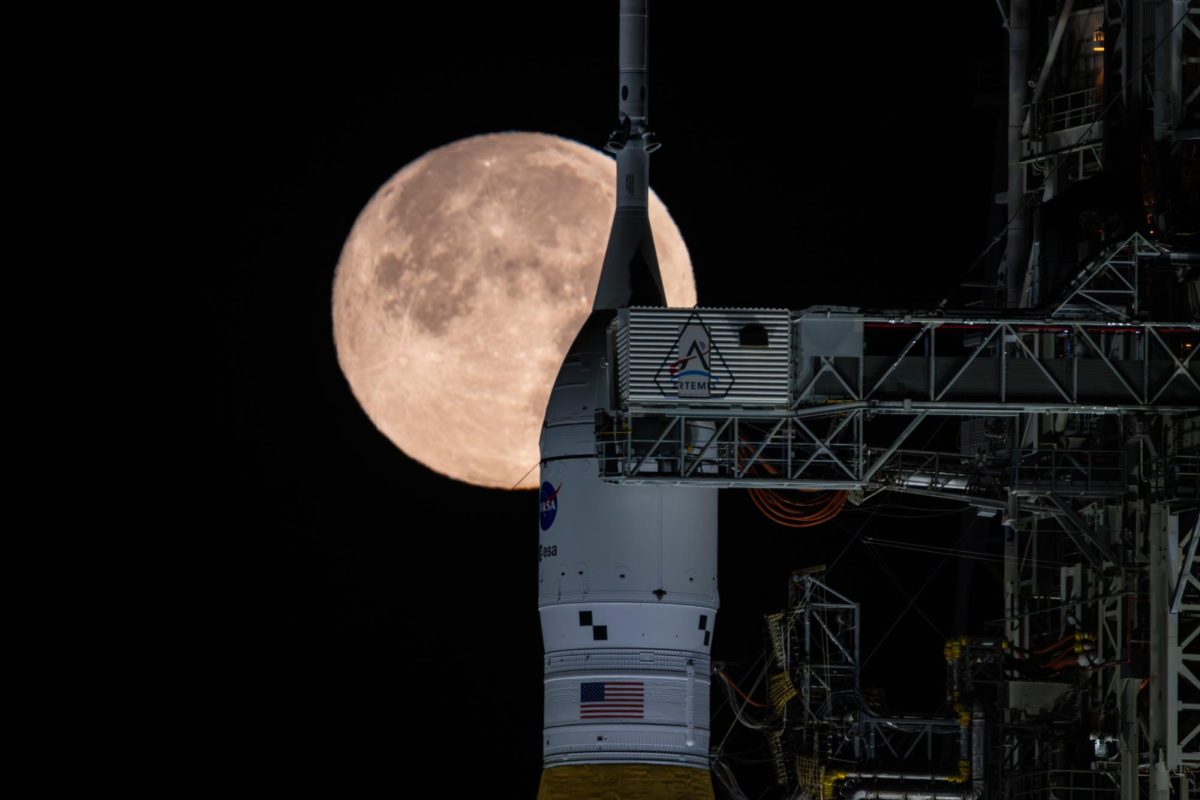
April 1, 2026 marked humanity’s return to deep space, as the National Aeronautics and Space Administration (NASA) launched the Artemis II rocket. As they were taking off from Florida, tens of thousands of spectators watched along from the beach and online to see the crew of four astronauts depart from Earth and venture to the moon.
Artemis II is venturing on a 10-day mission that will see the crew travel the closest to the moon that humans have been in over half a century. While they are not landing on the moon just yet, day six of the trip (April 7) will have the crowning achievement of a sweeping lunar flyby. This will give the crew a view of the moon’s far side to analyze specific geological features and take new pictures with high-tech cameras.
The mission is not just to send humans to the moon once again, but also has important studies being done specifically on the health of humans during spaceflight. New technology has been created that monitors health and performance.
AVATAR is a device that studies the effects of increased radiation and microgravity on crew health. Immune biomarkers will analyze blood and saliva samples of the crew to see how deep space changes the immune system. ARCHeR specifically monitors well-being, activity and sleep patterns of the crew and how it is affected by deep space. More radiation and astronaut health studies are also being conducted.
The Orion spacecraft will also be put through many planned tests to evaluate systems, procedures and performance in deep space. These tests will inform science operations about the strength and dependability of the spacecraft for future missions. The Artemis II mission is not just a return to deep space (which this mission will achieve by going around the moon and breaking the record for the farthest from Earth that an astronaut has traveled), but also ensuring safety of crew members for future missions as well by putting in place these technologies and studies.
The four-person crew of Artemis II is a crowning achievement. Commander Reid Wiseman is a 27-year Navy veteran. Pilot Victor Glover is the first Black man to ever venture into deep space. Mission specialist Christina Koch is the first woman to do so as well. Mission specialist Jeremy Hansen is the first Canadian to ever venture to the moon. He also serves as a special partnership between NASA and the Canadian Space Agency as he is the first non-American to be on a moon mission with NASA.
The Artemis II is the second of the planned five-part Artemis missions, which will send astronauts to explore more of the moon for scientific discovery, economic benefits and build foundations for an eventual crewed missions to Mars.
Artemis I launched on Nov. 16, 2022, and consisted of an uncrewed lunar flight test with the primary goal of ensuring future safety for humans to return to deep space. Artemis III is slated for 2027, testing commercial landers and docking capabilities that are needed in order to land astronauts on the moon. Artemis IV is targeted for early 2028 and will be the first manned lunar landing since 1972. Artemis V and subsequent missions have the goal of establishing a larger presence on the moon and in deep space.
The last time the United States sent humans to the moon was during the Apollo 17 mission, which landed on Dec. 11, 1972. Since then, uncrewed robotic missions have landed on the moon but no humans have returned nor been close. The Apollo missions ended in an era of financial cutbacks within government programs, where the only feasible thing that NASA could do was build a presence in low-Earth orbit. During this time, satellites were put in place and the International Space Station was created. Fifty years later, the Artemis missions began and marked a new beginning of space travel that intends to eclipse the space age.
Launched on April 1, 2026, an expected distance of over 695,000 miles will be traveled by the four-person crew on their expected 10-day mission aboard the Orion spacecraft. Real-time coverage of the mission can be seen from NASA’s YouTube channel, which gives views from the Orion spacecraft and mission control. The Artemis II mission is a shining light for the new era of space travel.