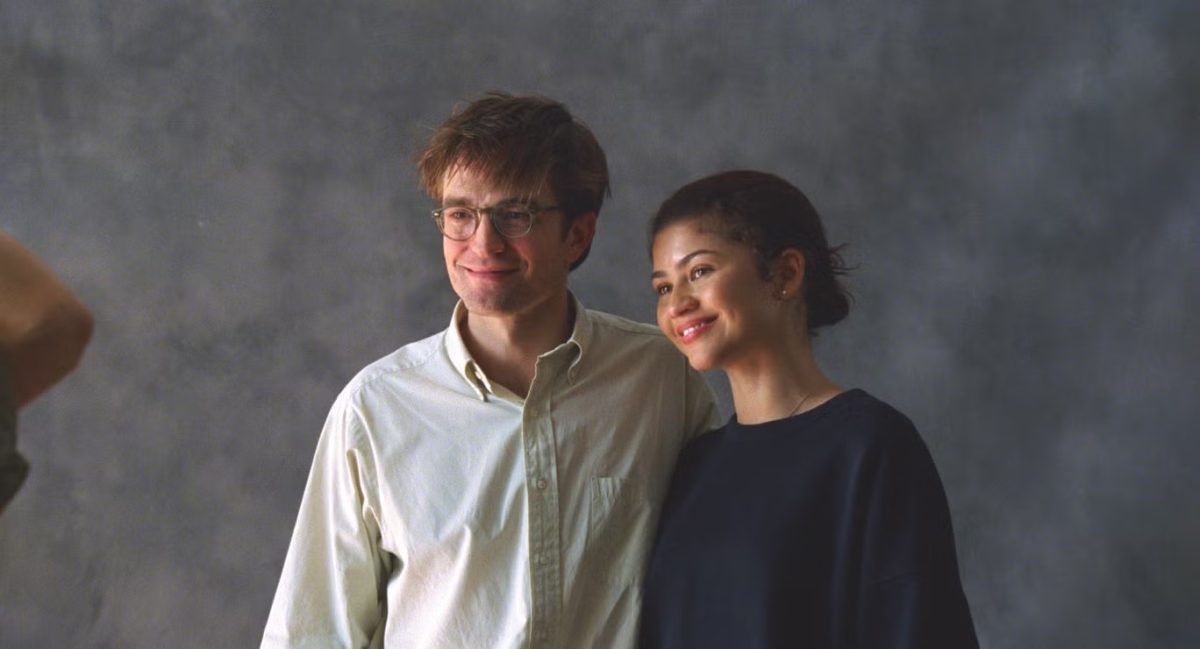
“The Drama” is 2026’s latest cinematic thought experiment. Written and directed by Kristoffer Borgli, the film stars Robert Pattinson and Zendaya as soon-to-be-married Charlie and Emma, who are preparing to be married amidst copious amounts of, you guessed it, drama.
The film begins with jarring, intercut sequences of Charlie and Emma talking with their friends about the upcoming wedding, with Charlie struggling to write a touching speech for his future wife. For about 20 minutes, the viewer is placed in the middle of a relationship and given small hints of how each truly feels about the other until one plot-shaking sequence.
The film’s crux lies within a single dinner scene in which Emma confesses a deeply personal fact about herself to Charlie, his best man Mike and Mike’s girlfriend Rachel (played stunningly by Alana Haim). Briefly shown in the film’s trailer, what one might expect the film to be about is quickly and dramatically turned on its head as Emma divulges her past.
Suddenly, what was once a straightforward wedding week becomes a field of landmines for the couple. As Emma is ostracized by Charlie, Mike and Rachel, her mental state begins to deteriorate into hypothetical scenarios of her own imagining. While some films talk about ideas like unrequited longing, “The Drama” presents Emma’s anxious unraveling through skilled editing, heartbreaking flashbacks and a completely unempathetic Charlie.
Pattinson ranges across the emotional spectrum, from desperate to charming to downright despicable. While Zendaya’s Emma asks the audience to interrogate its preconceived biases, Charlie shows the audience the limits of selfish desire for public approval, providing fascinating chemistry between the two leads. Accompanying them, Mamoudou Athie as Mike and Haim as Rachel perfectly encapsulate the oppressive nature of a disapproving and confused society, while Jeremy Levick’s bumbling DJ Ivan provides crucial comic relief in the third act. Each actor contributes greatly to one of the best-casted films in recent memory.
While the film is unique in concept alone, Borgli goes a step further in depicting Emma’s partial deafness. While her disability is important to the plot, it may be even more significant to the movie-going experience: when she is present in a scene, the film’s sound dampens on the right side of the theater. Many films have strong plots with little follow-through in the theatrical elements that define cinema; “The Drama” is not one of them.
Romantic comedies and dramas of the past have adhered closely to genre beats, in which one hopeless romantic finds the perfect person with minor faults that can be resolved in 90 minutes. “The Drama” differs sharply, with Charlie and Emma each presenting thoughtful moral quandaries about love, connection and interpersonal understanding in the 2020s. How would you, as a viewer, act in Charlie’s situation: emotionally shocked by your fiancée mere days before your wedding? While the question may seem simple, the film ensures you are pondering the answer throughout.
While Borgli’s last feature “Dream Scenario” meandered for 100 minutes in search of significance, “The Drama” has something profound to say from the first second to the last. With dynamic performances, shockingly black humor and a poignant message to share, “The Drama” is well worth watching.