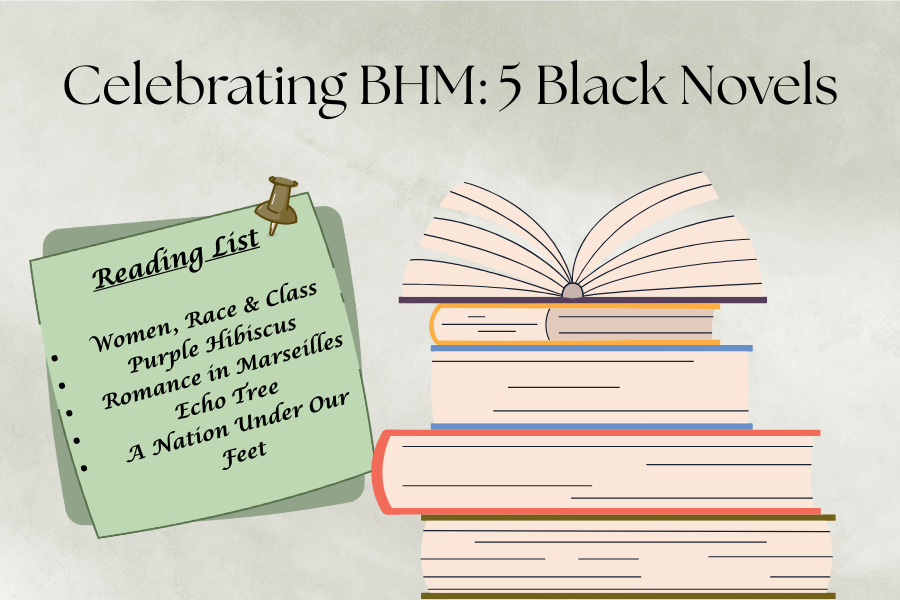
In this final installment of Celebrating Black History Month, I will be looking at five novels written by Black authors which are incredibly worthy of your attention. Literature allows us to see into interior worlds we could never imagine, and in this way, these novels may be the most impactful and important media I have recommended this month. While music can mean different things to different people because of its auditory quality, and films can elicit vastly different interpretations depending on the viewer, novels truly provide a comprehensive guide to the world their authors wished to evoke in our minds. Please enjoy these recommendations and remember to check them out at Collins Library too!
Women, Race and Class (Written by Angela Davis)
This might be odd, but I’m starting this list with a book I couldn’t even begin to paraphrase and is technically not a novel, but Angela Davis is too good of a writer not to recommend… Consisting of 13 essays by the famed political activist covering topics like gender, race, class, sexual assault, eugenics, the historical legacy of slavery, women’s liberation movements, racialized stereotypes of Black men and women and so, so much more; Davis succinctly and articulately discusses what many would have trouble expressing even on their best days.
Though the term was coined by Kimberlé Crenshaw in 1989, “Women, Race and Class” is one of the first recorded examples of intersectionality as political praxis. Asking individuals to consider how gender, race, class, sexuality, and other key social identity factors interact with each other in curating our social interactions and experiences with others, intersectionality is at the forefront of nearly every essay in this book as Davis avoids asking “How does _____ affect women,” but rather “How does ______ affect Black women? How do white women contribute to these effects? How are Black men’s experiences different from Black women?”
An absolutely essential read for anyone out there feeling dazed in our modern times, Davis produced a seminal text of political theory which is applicable to this day.
Purple Hibiscus (Written by Chimamanda Ngozi Adichie)
Religious trauma, parental abuse, familial bonds and identity are effortlessly explored in Chimamanda Ngozi Adichie’s debut novel “Purple Hibiscus.” Following 15-year-old Kambili Achike in the Enugu State of Nigeria as she grows to become her own woman, the novel is plagued by the presence of her father Eugene, a devout Catholic and community leader who abuses Kambili’s mother (Beatrice) and brother (Jaja) when at home.
When Kambili and Jaja are given a chance to stay with their aunt, Ifeoma, they find accommodation lacking as far as electricity and space go but feel more comfortable than they ever had in their lives. Allowed to speak their minds, come to their own conclusions about the world and listen to music, Ifeoma’s home becomes like a cocoon for the siblings to grow and flourish. Though tragedy strikes, the lessons learned by Kambili’s family remain with them and you, the reader, long after the final sentence has been read.
Incorporating both Igbo and English, Adichie weaves a coming-of-age story that feels less like a book and more like a flowing tapestry.
Romance in Marseille (Written by Claude McKay)
Featuring a disabled protagonist, a queer cast of characters and the legal triumph of a Black man over the white system, you would never believe this book was written in 1933; hence why it is such an important text, and why it went unpublished for 87 years. Considered too atypical to be released by McKay’s editors, this novel feels far more realistic and moving than much of what was commonly published at the time.
Opening on Lafala, a West African immigrant in a hospital bed with his legs amputated, this novel centers the experiences of the marginalized from the start and never lets off this empathetic pedal. A love letter to the queer, immigrant, differently abled and otherwise outcasted individuals that inhabit all our worlds, as well as the Black diaspora as a historical legacy, “Romance in Marseilles” feels like a warm hug transmitted across decades for those in need of visibility.
One feels seen when they read this book, a quality I find beautiful even in novels that didn’t take the better part of a century to see the light of day.
Echo Tree (Written by Henry Dumas)
If you are unfamiliar with the literary and film genre of Afro-Futurism, Henry Dumas’ short story collection is a fantastic place to start. With many of his stories taking place in the past, Dumas constructs a mythological, magical world around his often-young characters, allowing them to experience and endure the protagonist role which white characters have embodied constantly throughout most popular media in the 20th and 21st centuries.
In the tale “Ark of Bones,” a simple fishing expedition quickly becomes a mind-bending meditation on Black bodies in history while Biblical and impossible events occur on the water below. In “Goodbye, Sweetwater,” a young Black man seeks to be more than what is offered to him in his small town while still feeling emotionally shackled to the racial dynamics apparent everywhere around him. In “Will the Circle Remain Unbroken?” a group of Black musicians (inspired partly by the great Sun Ra) discover a bizarre way to preserve their culture despite the virulent white admirers who crowd their club.
At many times odd, fascinating, unreal or all three, “Echo Tree” is a phenomenal exploration of how Black culture can be imbued into seemingly simple storytelling.
A Nation Under Our Feet (Written by Ta-Nehisi Coates)
You’ve more than likely seen director Ryan Coogler’s “Black Panther” duo-logy, starring a phenomenal cast including Chadwick Boseman, Letitia Wright, Michael B. Jordan, Angela Bassett, Lupita Nyong’o and Daniel Kaluuya. But if you’ve ever wondered where Marvel got the idea to examine the Black diaspora through the lens of one of its most iconic characters, look no further than Ta-Nehisi Coates’ first comic book run, “A Nation Under Our Feet.”
Featuring Wakandan king T’Challa fighting international crime while tension brews within his nation’s walls, Coates creates a nuanced iteration of Black Panther which doesn’t show Wakanda or its people as a monolithic group representative of all Black individuals. Though this monolith was likely helpful to white comic book writers for decades in giving them imagery and world-building illustrations, Coates recognized that such simple stereotypes would be a waste of time for modern comic readers, especially Black readers seeking a complex representation of their culture so often simplified within the Black Panther canon.
A refreshing glimpse into Black culture by way of superhero aesthetics, I highly recommend this comic book.
Though unfortunate that this is the last Black History Month article I post this year, I feel happy knowing this media born of wildly different experiences and art styles is out in the world, recommended to you. And, if all goes well, a third iteration of this series will be yours in less than a year!
Happy Black History Month, it has been a pleasure to write for you. Now please go read some of these books.